Content sites & media
9 checksBlogs, news, docs, and marketing sites that want AI search engines to find, read, and cite their pages. Focuses on discoverability, server-rendered content, and clear bot rules.
Check whether ChatGPT, Perplexity, Claude, and Google AI can read your site — and get a prioritized list of fixes to send to your team.
Every scan turns into four things you can act on: a single score, the blockers behind it, the first fixes ranked by impact, and a ready-to-send task for your developer — no scoring internals, no jargon.
Quickly see how ready the site is for AI search and AI agents.
See where the site is hard to find, read, or use.
Get plain-language recommendations for your team or contractor.
Ready text you can send to Telegram or Jira.
Each scan runs more than a dozen checks grouped into five areas. Together they describe how an AI crawler or agent discovers your site, reads its content, respects your access rules, and finds the protocols it needs to act.
robots.txt · sitemap.xml · Link headers
HTML without JS · Markdown negotiation · llms.txt files · Meta & structured data
AI bot rules · robots directives
MCP discovery · OAuth discovery · API catalog
Agent commerce
Every scan ends with a single Agent Readiness Score from 0 to 100. The score is a weighted roll-up of the individual checks: each check passes, partially passes, or fails, and contributes to the categories above according to how much it matters for AI agents.
Weighting is profile-aware. A content site is scored mostly on discoverability and readable content, an API or SaaS product leans on protocol and API discovery, and an e-commerce store adds commerce signals. Picking the right profile in the form changes which checks run and how heavily each one counts.
The score is evidence-based: every result links back to the public HTTP responses, headers, and files the scanner actually saw, so your team can reproduce and fix each finding. It reflects public signals at scan time, not a guarantee about future AI traffic.
For the full list of what the score does and doesn't promise, see the disclaimer.
The scan adapts to the kind of site you run. Choose a profile to match your site, or run every check at once.
Blogs, news, docs, and marketing sites that want AI search engines to find, read, and cite their pages. Focuses on discoverability, server-rendered content, and clear bot rules.
Apps and platforms that expose data or actions to AI agents. Adds protocol and API discovery — MCP, OAuth, and API catalogs — on top of the discoverability and bot-rule checks.
Shops that want products and prices to be readable by AI shopping assistants. Adds commerce signals to the content and discoverability checks.
Practical guides on making your site readable, discoverable, and callable by AI agents.
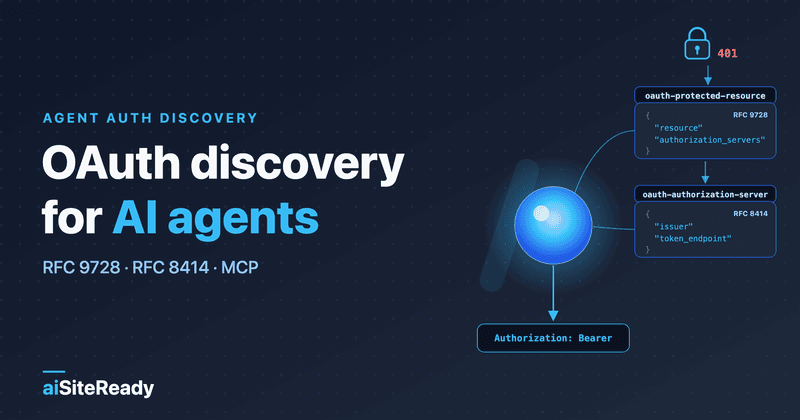
OAuth discovery for AI agents: a 401 points to RFC 9728 resource metadata, then RFC 8414 server metadata. 2 JSON files, 8 pitfalls, and when to skip it.
Oct 26, 2026
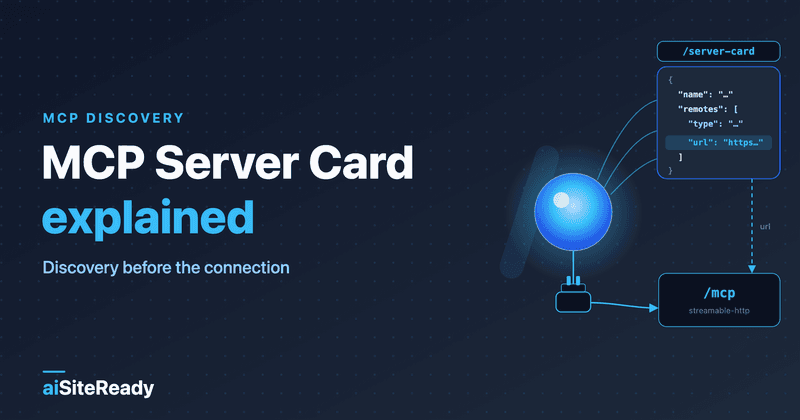
An MCP Server Card is a JSON file that tells clients where your remote MCP server lives. Fields, hosting, curl checks, and its draft status in October 2026.
Oct 23, 2026
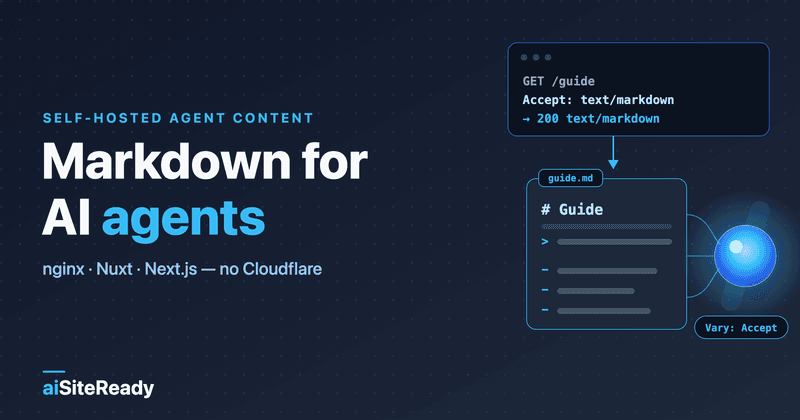
Serve Markdown to AI agents without Cloudflare: an nginx map for Accept: text/markdown, Nuxt and Next.js code, Vary: Accept, and a 9-check curl test script.
Oct 20, 2026
AI agent readiness is how easily AI crawlers, assistants, and autonomous agents — like ChatGPT, Perplexity, Claude, and Google AI — can discover your site, read its content without running JavaScript, understand your access rules, and find the protocols they need to act on it. A ready site is visible and usable to these tools; an unready one is invisible or blocked.
It overlaps but is not the same. Classic SEO optimizes for human visitors arriving through search-result pages. Agent readiness optimizes for machines that read your content directly and act on it — checking things like llms.txt, server-side rendering, AI bot rules, and machine-readable protocols that traditional SEO tools ignore.
llms.txt is a proposed plain-text or Markdown file at the root of your site that gives AI models a curated, easy-to-read map of your most important content. It is optional and still emerging, but adding one is a low-effort way to make your key pages easier for AI agents to find and summarize. The scan tells you whether yours is present and reachable.
The scan looks for explicit rules for the major AI crawlers, including GPTBot (OpenAI), ClaudeBot (Anthropic), and PerplexityBot, alongside general directives such as noai and noimageai. It reports whether your robots.txt allows, blocks, or simply ignores these agents, so you can decide access on purpose rather than by accident.
Yes — the scan is free and needs no sign-up. To keep the service available for everyone, the MVP limits you to about five checks per day from the same browser. Teams that need batch checks or API access can reach out; bulk scanning is planned after the MVP.
We store only what is needed to build and show your report: the submitted URL, the scan profile, and limited public evidence such as status codes, selected headers, discovered files, and short snippets. Full HTML is not stored by default, and the scanner only ever reads public pages.
No. The scanner only reaches public HTTP and HTTPS URLs. It validates DNS and every redirect and blocks private, loopback, link-local, and cloud-metadata addresses to prevent server-side request forgery, so it cannot sign in, submit forms, or reach internal or staging environments.
Lighthouse measures performance, accessibility, and SEO for human users in a browser. This scan asks a different question: can an AI agent discover, read, and act on your site? It checks AI bot rules, llms.txt, machine-readable protocols, and content available without executing JavaScript — signals a Lighthouse run does not cover.
It depends on the finding. Many fixes are configuration — adding rules to robots.txt, publishing a sitemap or llms.txt, or exposing structured data. Others, like making key content available without JavaScript, may need a developer. Every result comes with plain-language guidance and a ready-to-send task for your team.
Not directly. The score reflects how ready your site is for AI agents, not your position in classic search results. That said, many readiness signals — fast, server-rendered, well-structured content with clear crawler rules — also help traditional search. The scan is a readiness diagnostic, not a ranking guarantee.